

AI essay humanization sits at the center of one of the biggest conversations in education right now. Students everywhere are using AI tools like ChatGPT and Claude to draft essays faster than ever before. But here is the problem: when you submit that essay through a Turnitin check, there is a real chance the system flags it as AI-generated. That flag can trigger academic integrity reviews, lowered grades, or worse. So what exactly is AI essay humanization, and why has it become something students need to understand? This guide breaks it all down without the fluff.
What Is AI Essay Humanization?
AI essay humanization is the process of rewriting AI-generated text so it reads like a real person wrote it. The goal is more than changing a few words around. A proper humanization overhaul targets the structural patterns that AI detectors hunt for: overly uniform sentence lengths, predictable word choices, robotic transitions, and that strangely perfect grammar that no actual human produces consistently.
When you run a draft through ChatGPT, the output makes sense. It is coherent, organized, and usually factually sound. But it also carries statistical fingerprints. AI detection tools like Turnitin for students, GPTZero, and Originality.ai have been trained to spot those fingerprints. They look at two main signals: perplexity (how unpredictable your word choices are) and burstiness (how much your sentence length and structure vary). AI text tends to score low on both. Humanizing your essay means raising those scores organically so the text behaves like human writing under algorithmic scrutiny.
Why Students Turn to Essay Humanization Services
Let us be honest about the pressures students face. You are juggling multiple deadlines, part-time work, and the expectation to produce polished academic prose on topics you may not fully grasp yet. AI writing tools offer a starting point. They help you outline arguments, generate ideas, and get words on the page when staring at a blank document feels impossible.
But using AI as a brainstorming partner and submitting raw AI output are two very different things. Most universities now run submissions through a Turnitin scan that includes AI detection. Even if your professor allows limited AI use, they want to see your thinking, your voice, your engagement with the material. That gap between AI draft and submission-ready essay is exactly where humanization comes in.
Students use essay humanization for several legitimate reasons:
- Refining tone and voice. Raw AI output sounds generic. Humanization injects personality, opinion, and the kind of stylistic variation that reflects actual student writing.
- Fixing factual errors. AI hallucinates sources, misrepresents data, and invents citations. A human review catches these errors before submission.
- Adding lived detail. AI cannot share personal experience, specific examples from your coursework, or observations from your own life. These details make writing authentically yours.
- Meeting academic standards. Proper citation, formatting, and argument structure still matter. Humanization includes these elements, not only paraphrasing.
How Turnitin AI Detection Actually Works
To understand why humanization matters, you need to know what happens when your essay hits Turnitin. Most students think of Turnitin as a plagiarism checker, and that part still exists. The Similarity Report compares your submission against billions of web pages, journal articles, and previously submitted papers to find text overlap. But since April 2023, Turnitin also runs an AI writing detection scan.
Here is how the Turnitin AI detection process breaks down your submission:
- Your document gets segmented into chunks of roughly five to ten sentences. These segments overlap so each sentence gets analyzed in context.
- Turnitin’s transformer-based model scores each sentence on a scale from 0 to 1. A score near 0 means likely human-written; near 1 means likely AI-generated.
- The system averages these scores and produces an overall percentage of text flagged as potentially AI-written.
- Results display in color-coded highlights: cyan for likely AI-generated text, purple for AI-generated text that was then paraphrased by another AI tool.
Turnitin only flags content when its model reaches at least 98% confidence. The company reports a document false positive rate below 1% for submissions with over 20% AI-detected text. However, scores between 0% and 19% get marked with an asterisk because false positives are more common in that range. Sentence-level false positives sit around 4%, especially near transitions between human-written and AI-written sections.
For a deeper look at how Turnitin structures its AI detection reports and what the percentage scores mean, you can refer to the official documentation: Using the AI Writing Report.
The Difference Between a Turnitin Check and AI Detection
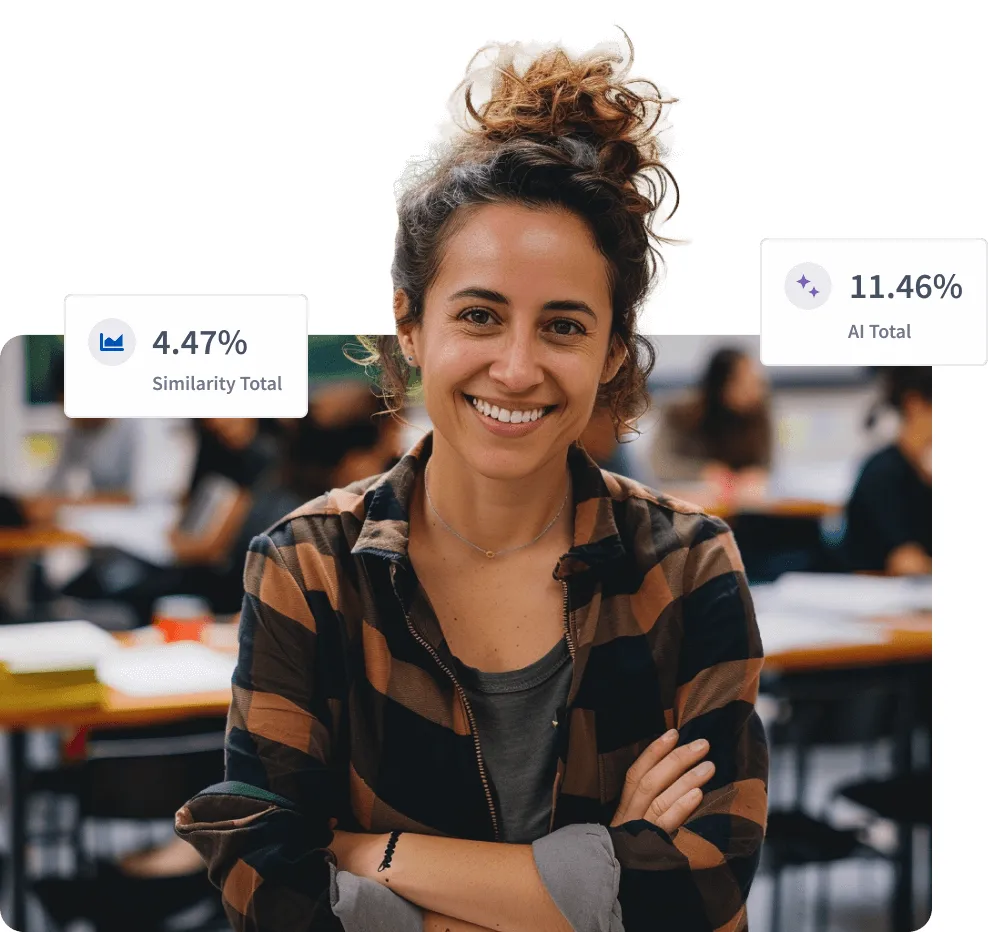
Many students confuse these two reports, but they measure completely different things. Your Similarity Score shows what percentage of your text matches existing sources. It catches direct copying, poor paraphrasing, and missing citations. Your AI Detection Percentage estimates how much of your text was likely generated by an AI tool. These scores operate independently.
You could have a 5% similarity score and a 70% AI detection score. That means your text barely matches any existing sources, but it strongly resembles AI-generated prose. Conversely, you could score 40% similarity and 0% AI if you quoted heavily from cited sources using your own words.
Understanding this distinction matters because the strategies for fixing each problem differ. High similarity requires better paraphrasing and citation. High AI detection requires structural rewriting to break the patterns that machines produce.
What the Turnitin Scan Flags Beyond Plagiarism
Modern Turnitin for students also includes a Flags panel that catches attempts to game the system. This includes hidden text (white font on white background), replaced characters using homoglyphs, and other manipulation tricks. Turnitin processes submissions against its repository of student papers, current and archived web content, and premium publication databases spanning 170 languages.
When you submit, your file waits in a processing queue. Most reports generate within 15 to 20 minutes, though repeated resubmissions can trigger a 24-hour delay. Your instructor controls if you see the similarity report at all. AI writing reports, however, are almost never visible to students directly.
Can You Really Beat Turnitin AI Detection?
This is the question that drives most searches on the topic. The short answer: raw, unedited AI output will get caught by Turnitin most of the time. The longer answer: you can beat Turnitin AI detection through substantive rewriting, but not through cheap tricks.
Here is what does not work in 2025:
- Simple paraphrasing tools like basic QuillBot modes. Turnitin has been retrained to detect AI-paraphrased text and flags it in purple.
- Synonym swapping. Changing “utilize” to “use” does not alter the underlying sentence patterns detectors analyze.
- Adding typos or grammar mistakes on purpose. This looks suspicious and hurts readability without reliably fooling detection models.
- Using homoglyphs or hidden characters. Turnitin’s Flags panel catches these immediately.
What actually works is genuine rewriting at the structural level. That means varying your sentence rhythm, adding personal detail, restructuring paragraphs, and writing in a voice that sounds like you. This is what professional essay humanization services do, and it is what you can learn to do yourself.
Manual Techniques to Humanize AI Writing
If you want to transform an AI draft into something that passes a Turnitin check, here is a practical workflow:
- Get a baseline. Run your raw AI text through a detector. See where it stands before you edit.
- Rewrite sentences structurally. Do not only swap words. Split long sentences. Combine short ones. Change the order of clauses. Introduce questions.
- Add your voice. Include a personal anecdote, a specific example from your course, an opinion, or a counterargument. AI cannot generate lived experience.
- Fix the transitions. AI loves “however,” “furthermore,” and “in conclusion.” Replace these with natural transitions like “but here is the thing” or “on the flip side.”
- Simplify the language. AI overuses formal words. Swap “commence” for “start.” Replace “leverage” with “use.” Your writing should sound like a smart student, not a thesaurus.
- Vary paragraph length. AI produces blocks of uniform length. Mix a one-sentence paragraph with a longer explanatory one.
- Verify every fact and citation. AI invents sources. Check every claim, find real citations, and format them correctly.
- Run a final check. Test your edited text against detection tools to confirm your changes worked.
Bypass GPTZero and Other Detectors: What You Should Know
Turnitin dominates the academic market, but it is not the only detector students encounter. GPTZero popularized AI detection with its focus on perplexity scoring and has since added specific labeling for possible AI-paraphrased content. Originality.ai targets content publishers and marketers. Copyleaks serves enterprise and educational institutions. Each uses slightly different models, which means text that passes one detector might not pass another.
The idea that you can bypass GPTZero or Turnitin with a single magic tool is misleading. Detection models update continuously. Turnitin releases model updates several times per year, refining accuracy and reducing false positives. GPTZero has upgraded its detection of paraphrased text. What worked six months ago may not work today.
This is why the most reliable approach to creating undetectable AI essay content is not tool-dependent. It is process-dependent. Build your essays through a combination of AI-assisted drafting and substantial human editing. Think of AI as a research assistant or outline generator, not a ghostwriter. The more of your own thinking, analysis, and voice you add, the less detectable the final product becomes.
The Problem with AI Detection Remover Tools
A whole industry of AI detection remover tools has emerged promising to make AI text undetectable with one click. Some of these tools work better than others, but they all share limitations.
First, they engage in an arms race they cannot guarantee winning. Detection models evolve. A tool that bypasses Turnitin today might fail tomorrow after a model update. Second, many detection removers simply restructure text at a shallow level without improving quality. The output might pass a scan but read awkwardly or contain factual errors. Third, relying entirely on automated tools means you are not developing the writing skills that your degree is supposed to represent.
That said, quality humanizer tools can serve as a starting point in your editing workflow. The best ones restructure sentence patterns, vary paragraph flow, and adjust the statistical signals that detectors measure. They get you part of the way there. The final polish, the fact-checking, the voice injection, that still requires a human touch. Yours.
When Humanization Crosses into Academic Dishonesty
This topic carries real ethical weight, and pretending otherwise would be dishonest. Using AI to generate an entire essay and then humanizing it to hide that fact is academic misconduct at most institutions. Full stop. If your syllabus prohibits AI use for submitted work, then humanizing AI output to evade that rule violates your school’s policy.
But the ethical picture has nuance. Many professors now permit limited AI use for brainstorming, outlining, or checking grammar. In these cases, humanization functions as editing. You are taking a rough starting point and transforming it into original work that reflects your understanding. The line between acceptable assistance and cheating depends on your instructor’s specific rules.
Before you use any tool to bypass AI essay detectors, read your course policies. Ask your professor directly if the rules are unclear. The consequences of getting caught, essay humanization or not, are not worth the risk of guessing wrong.
Choosing an Essay Humanization Service
If you decide to use a professional essay humanization service, know what separates quality providers from scams. Here are the factors that matter:
| Feature | What to Look For | Red Flags |
|---|---|---|
| Editing approach | Manual rewriting by subject-matter experts with structural changes | Automated synonym swapping with no human review |
| Fact-checking | Verification of all claims and citations against real sources | No mention of accuracy checks; AI-generated fake citations left intact |
| Style matching | Ability to match your writing voice using samples of your past work | Generic output that sounds nothing like you |
| Transparency | Clear explanation of their process and realistic success rates | Guarantees of 100% undetectability; claims of fooling all detectors |
| Privacy | No storage of your essays; secure processing with data deletion after delivery | Vague privacy policies; essays retained in databases for reuse |
Services that promise to help you humanize AI essay content should focus on making the writing authentically yours, not only statistically different enough to pass a scan. The best outcomes come from services that treat humanization as editorial craft, not technical trickery.
Practical Tips for Writing That Passes Detection
If you use a service or handle humanization yourself, these habits will make your writing sound more human and perform better against any detector:
- Write sections from scratch without AI. Even a few fully human-written paragraphs mixed into an AI draft disrupt the statistical patterns detectors analyze.
- Use the 12-minute human edit. Read your draft aloud. Fix the three places where you stumble. Add one concrete detail, one opinion, and one counterargument. Kill hedging phrases like “very” and “extremely.”
- Keep a writing journal. The more you practice writing in your natural voice, the easier it becomes to spot AI-generated passages that do not sound like you.
- Cite generously and correctly. Proper attribution reduces similarity scores and shows engagement with real sources. It also builds the kind of academic writing habits that professors want to see.
- Save your drafts. If a professor questions your work, having earlier drafts demonstrates your writing process and can resolve misunderstandings quickly.
Frequently Asked Questions
Does Turnitin detect all AI-generated text?
No. Turnitin acknowledges that roughly 15% of AI-written text may go undetected, particularly heavily edited or hybrid human-AI content. Conversely, the system occasionally flags human-written text as AI, especially for non-native English speakers whose writing follows more predictable patterns.
Can I see my own Turnitin AI detection score?
In most cases, no. Turnitin makes AI writing reports visible to instructors, not students. Your instructor can choose to share the report with you, but the default setting hides it. You may only see your Similarity Score, depending on how your instructor configured the assignment.
Is using an AI humanizer considered cheating?
It depends on context and institutional policy. If your school prohibits AI use entirely, then using a humanizer to disguise AI-generated work constitutes academic dishonesty. If your instructor allows AI for drafting or brainstorming, humanizing that draft into original work falls within acceptable use. Always check your specific course policies.
What is the minimum word count for Turnitin AI detection?
Turnitin requires at least 300 words of prose text in a supported file format to generate an AI Writing Report. Documents shorter than this, or those written primarily in bullet points, tables, or code, will not produce an AI detection score.
Do free AI detection removers actually work?
Some work better than others, but none offer guaranteed results. Free tools typically have word limits and use less sophisticated rewriting models. More importantly, many free detection tools are themselves inaccurate and may flag human-written text as AI just to upsell you on their premium humanizer. Be cautious about uploading your original work to unknown platforms.
Can I get in trouble if Turnitin falsely flags my human-written essay as AI?
A false positive alone should not result in disciplinary action. Turnitin explicitly states that its AI detection should not be used as the sole basis for adverse decisions. If your instructor raises a concern, provide drafts, notes, and source materials that document your writing process. Most institutions require additional evidence beyond a detection score before pursuing academic misconduct charges.
Does humanized AI content rank well for SEO?
For content creators and marketers, humanized AI text generally performs better than raw AI output because it reads more naturally and engages readers longer. Google prioritizes helpful, people-first content regardless of how it was produced. The key factor is quality and usefulness, not the method of creation.
How often does Turnitin update its AI detection model?
Turnitin releases updates several times per year. Recent updates have improved Spanish-language detection, reduced false positives, and enhanced detection of AI-paraphrased content. These updates are not retroactive; previously submitted papers keep their original AI scores unless resubmitted.
What languages does Turnitin AI detection support?
As of 2025, Turnitin supports AI writing detection in English, Spanish, and Japanese. AI paraphrasing detection is available for English only. Support for additional languages is under development.
Are essay humanization services legal?
Yes, essay humanization services operate legally. However, using them to submit work that misrepresents your own writing abilities may violate your school’s academic integrity policy. The services themselves are tools; how you use them determines if you stay within ethical boundaries.
Final Thoughts
AI essay humanization is not going away. As long as students use AI writing tools and institutions deploy AI detectors, there will be a gap between machine-generated drafts and submission-ready academic work. Understanding how Turnitin for students works, what the Turnitin scan actually measures, and how to legitimately improve your writing gives you an advantage that no bypass tool can match.
The bottom line: use AI as a starting point if your policies allow it, but put in the work to make the final product yours. Vary your sentences. Add your experiences. Check your facts. Write like a person, because at the end of the day, you are one. That authenticity is the only thing no detector can ever truly penalize.
Beat Plagiarism & AI Detectors with Confidence
Worried about plagiarism scores or AI detection flags? Get Plagiarism reports, expert humanization, and original papers written from scratch — all in one place and before your deadline.
100% Confidential • Turnaround as fast as 3 hours • Money-back guarantee