

Compare AI essay humanization tools with traditional writing methods, and learn what Turnitin AI detection actually catches before risking your academic integrity.
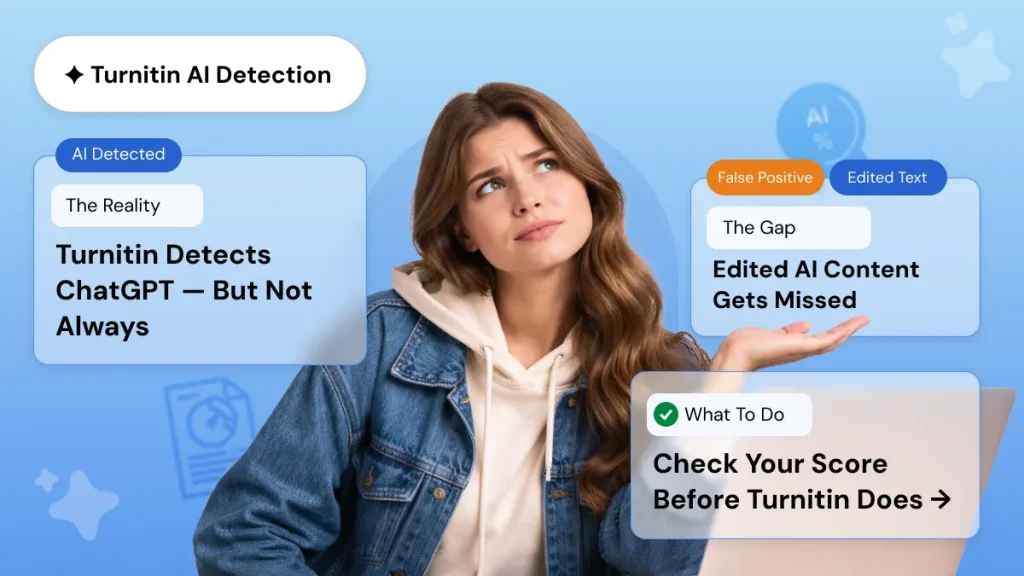
AI essay humanization is everywhere right now. Students paste ChatGPT drafts into rewriting tools, hoping the output will pass a Turnitin check without raising flags. Others swear by writing every word themselves, convinced that nothing beats sitting down with research notes and a blank page. Both approaches have real merits, and both come with problems worth understanding before you submit your next assignment.
This article breaks down what AI essay humanization actually does, how traditional essay writing compares, and what you need to know about Turnitin AI detection, Turnitin scan results, and the tools claiming to bypass GPTZero or beat Turnitin AI detection. By the end, you will have a clear picture of which method fits your situation.
What Is AI Essay Humanization?
AI essay humanization is the process of rewriting machine-generated text so it sounds like a person wrote it. You start with content from ChatGPT, Claude, Gemini, or another AI writing tool. Then you run it through an essay humanization service that changes sentence structure, swaps vocabulary, and adds natural variation. The goal is an undetectable AI essay that passes scrutiny from Turnitin for students and similar platforms.
These tools market themselves as AI detection removers. Some claim to bypass AI essay detectors entirely, promising output that scores 0% AI on a Turnitin scan. Others focus on improving readability while keeping the core ideas intact. The technology behind them varies. Some use rule-based rewriting. Others rely on their own language models trained specifically to mimic human writing patterns.
How Traditional Essay Writing Holds Up
Traditional essay writing means you do the work yourself. You research, outline, draft, revise, and polish. No AI generates your sentences. No humanizer rewrites your paragraphs. You build the argument from scratch, cite your sources manually, and live with the occasional awkward phrasing that comes from real human effort.
This approach has been the standard in academia for decades. It forces you to think through your position, find evidence that supports it, and articulate your reasoning in your own voice. Instructors can spot genuine engagement with material. Your writing develops over time, and you get better at structuring arguments with every paper you complete.
The Pros of AI Essay Humanization
Speed and Efficiency
The biggest draw is time. You can generate a full draft with AI, humanize it, and have something submission-ready in under an hour. For students juggling multiple deadlines, jobs, or personal responsibilities, this efficiency matters. An essay humanization service compresses what used to take days into a single afternoon.
Idea Generation
Even if you write the final paper yourself, AI can help you brainstorm angles you had not considered. You might ask it for counterarguments, alternative thesis statements, or source suggestions. Humanizing the output gives you a jumping-off point rather than a finished product, which can beat writer’s block.
Language Support
If English is not your first language, AI humanization tools can help you express complex ideas more fluently. They adjust phrasing, fix grammar issues, and make your writing sound more natural. This levels the playing field for international students who understand course material but struggle with academic English conventions.
Plagiarism-Free Output
Most humanization tools rewrite content enough that it will not trigger a standard plagiarism flag. The text becomes original in a technical sense, even if the ideas came from an AI. For students worried about accidental plagiarism from paraphrasing too closely, this offers some peace of mind.
The Cons of AI Essay Humanization
Detection Risk Is Real
No humanization tool is perfect. Turnitin’s AI detection has become significantly more sophisticated since 2023. Independent testing from Temple University found that Turnitin correctly identified 77% of purely AI-generated samples and 86% of samples where AI was used at all. When researchers ran AI text through free paraphrasing tools to disguise it, Turnitin still caught 63% of those attempts.
The University of Melbourne’s academic integrity office has warned students that many free AI detection remover tools online are themselves exploitative. They claim to humanize your text but often use methods that Turnitin still flags. Some even store your submissions and reuse them, creating future plagiarism risks.
Loss of Critical Thinking Practice
Every time you outsource the writing process, you miss an opportunity to develop your thinking. Essay writing is not just about producing a document. It is about wrestling with ideas, organizing your thoughts, and learning to communicate persuasively. Relying on AI humanization stunts that growth.
Inconsistent Quality
Humanized essays often read strangely. Sentences vary in tone. Transitions feel forced. Some paragraphs flow well while others sound like they came from a completely different writer. Instructors who read dozens of student papers can spot these inconsistencies. The writing might pass a Turnitin scan and still raise eyebrows during grading.
Ethical and Policy Issues
Most universities have updated their academic integrity policies to address AI use. Submitting humanized AI text often violates these policies even if the text passes detection. The issue is not plagiarism in the traditional sense. It is misrepresentation. You are claiming work as your own that you did not actually produce. If your institution requires process documentation, draft submissions, or in-class writing samples, the risk of getting caught increases substantially.
Understanding Turnitin AI Detection
Turnitin AI detection works differently from its similarity checker. While the similarity report looks for matching text against existing sources, the AI detection module analyzes writing patterns. It evaluates four main characteristics: perplexity, burstiness, repetitiveness, and generic or detached phrasing.
Perplexity measures how predictable your sentences are. Human writing tends to be less predictable because people mix up word choices and structures naturally. Burstiness tracks variation in sentence length. Humans write short sentences after long ones. AI often produces more uniform pacing. Repetitiveness flags overused transition words like additionally, moreover, and therefore. The system also looks for overly generic writing that lacks personal perspective or specific detail.
For a comprehensive understanding of how Turnitin processes submissions and generates reports, refer to the official support documentation on similarity scoring and report interpretation.
Official Turnitin Documentation: For a detailed breakdown of how similarity scores work and what they mean for your submissions, refer to the official support guide:.Understanding the similarity score
Turnitin for Students: What You Should Know
If your school uses Turnitin for students, you should understand a few key facts. First, the AI detection score is not visible to you by default. Only instructors see it. They may choose to share the report with you if concerns arise, but you cannot check your own AI score through the student portal.
Second, the percentage shown does not mean certainty. It represents the proportion of text that Turnitin classifies as likely AI-generated at a 98% confidence threshold. A score of 30% does not mean 30% of your essay is AI-written. It means Turnitin flagged that portion as matching patterns common in AI output.
Third, Turnitin scan results can vary based on document length, language, and genre. Short assignments under 300 words often produce unreliable scores. Highly structured writing like lab reports may trigger false positives. Non-native English writers sometimes get flagged because simpler syntax resembles AI patterns.
Can You Really Beat Turnitin AI Detection?
Tools that promise to bypass AI essay detectors or create undetectable AI essays are making claims that do not hold up under scrutiny. The research from Temple University demonstrated that heavily edited AI text still got caught over 60% of the time. Hybrid essays that mixed human and AI writing were the hardest to evaluate, but even then Turnitin identified 43% correctly as partially AI-generated.
The arms race framing is misleading. Detection tools improve continuously. Every time a new humanization method emerges, detection algorithms adapt. Relying on any single tool to beat Turnitin AI detection is a gamble where the odds worsen over time.
That said, detection is probabilistic, not perfect. Heavily revised drafts with substantial original writing, personal examples, and unique citations are harder to flag accurately. The best defense against detection is not a better humanizer. It is genuine human input throughout the writing process.
When Traditional Writing Still Wins
Traditional essay writing remains the better choice in several situations. If your instructor knows your writing style from previous assignments, a sudden shift in voice will raise suspicion. If the assignment requires reflection, personal narrative, or class-specific discussion, AI simply cannot replicate your lived experience. If your program emphasizes writing skills development, outsourcing essays defeats the entire purpose of the curriculum.
Additionally, some courses now require process documentation. You might need to submit outlines, drafts, research notes, or revision histories. In these cases, humanized AI output creates more problems than it solves. You either fabricate the process materials, compounding the dishonesty, or admit you used AI from the start.
Making the Right Choice for Your Situation
Your decision should depend on three factors: your institution’s policies, the assignment requirements, and your actual goals. If the policy bans AI entirely, the risk is obvious. If the assignment allows AI for brainstorming but requires original writing, use AI within those boundaries. If your goal is learning, there is no substitute for doing the work yourself.
For students who use AI as a starting point, the smartest approach is to treat humanized output as a rough draft. Rewrite it completely in your own words. Add personal examples, class references, and your own analytical voice. Run your final draft through available checkers before submission. This hybrid approach gives you some efficiency gains while maintaining enough original work to stand behind.
Quick Comparison: AI Humanization vs Traditional Writing
| Factor | AI Essay Humanization | Traditional Writing |
| Speed | Very fast; minutes per essay | Slow; hours to days |
| Detection Risk | Moderate to high | Very low |
| Skill Building | Minimal | Significant |
| Quality Consistency | Variable; can sound uneven | Matches your actual level |
| Policy Compliance | Often violates AI policies | Fully compliant |
| Cost | Free to $30+/month | Free (your time) |
| Instructor Trust | Can raise suspicion | Builds credibility over time |
Frequently Asked Questions
What is an AI essay humanizer?
An AI essay humanizer is a tool that rewrites machine-generated text to sound more natural and human. It changes sentence structures, varies vocabulary, and adjusts tone to help the text avoid detection by AI scanning tools.
Does humanized AI text always pass Turnitin?
No. Research shows Turnitin catches roughly 63% of disguised AI text and 77% of unedited AI output. Humanization improves your odds but offers no guarantee.
Can I get in trouble for using a humanization tool?
Yes, if your institution’s academic integrity policy prohibits AI use. The issue is misrepresentation, not just plagiarism. Check your syllabus or ask your instructor directly.
Is Turnitin AI detection accurate for non-native English speakers?
Turnitin publishes data showing no statistically significant bias against English Language Learners. However, simpler vocabulary and syntax can occasionally resemble AI patterns, so false positives happen.
What is the safest way to use AI for essay writing?
Use AI for brainstorming, outlining, and generating initial ideas. Write the actual essay yourself, incorporating your own examples and analysis. This gives you efficiency benefits while keeping the work authentically yours.
Are free AI detection remover tools safe?
Many free tools store your submissions and may reuse them. Some actually make your text easier to detect. The University of Melbourne and other institutions have warned students against using these services.
Can instructors tell if I used AI even if Turnitin does not flag it?
Yes. Instructors who read your work regularly can spot inconsistencies in voice, unusual phrasing, or content that does not match class discussions. Detection scores are just one tool they use.
What happens if my paper is flagged by Turnitin AI detection?
Flagging does not mean automatic punishment. Instructors are advised to use AI detection as a starting point for conversation, not proof of misconduct. They may ask you about your process, request drafts, or discuss the assignment with you before making any determination.
Final Thoughts
AI essay humanization offers real convenience, but it comes with meaningful risks. Detection technology keeps improving. Academic policies are tightening. The gap between humanized output and genuinely human writing is narrowing from a detection standpoint, but experienced instructors still notice when something feels off.
Traditional essay writing takes longer and demands more effort. It also builds skills you will use throughout your career. The ability to research, think critically, and communicate clearly in writing is not a checkbox to get past. It is a foundation for professional success.
The honest answer is that there is no perfect shortcut. Tools that claim to bypass GPTZero or create undetectable AI essays are selling hope, not certainty. Your best protection against any Turnitin check is work that is actually yours. Start early, use AI responsibly within your institution’s guidelines, and invest in developing your own writing voice. That investment pays off long after any single assignment.
Beat Plagiarism & AI Detectors with Confidence
Worried about plagiarism scores or AI detection flags? Get Plagiarism reports, expert humanization, and original papers written from scratch — all in one place and before your deadline.
100% Confidential • Turnaround as fast as 3 hours • Money-back guarantee