

Turnitin’s AI detection flags millions of papers, including false positives for ESL writers. Discover how real human writers can help your essay pass every scan.
Turnitin AI Humanizer Service: Bypass Detection with Real Human Writers
You spent hours refining an essay, only to watch Turnitin flag it as AI-generated. That sinking feeling is familiar to thousands of students. The reality is harsh: Turnitin AI detection has grown aggressive, and even original writing sometimes gets caught in the net. A Turnitin check now goes far beyond plagiarism scanning. It dissects your sentence structure, predicts your word choices, and assigns you a probability score that professors treat like a verdict.
This is exactly why a Turnitin AI humanizer service built around real human writers has become essential for students who need to beat Turnitin AI detection without gambling their academic standing.
How Turnitin Checks Your Writing (And Why It Gets Things Wrong)
Turnitin launched its AI detection engine in April 2023, and it has evolved rapidly. The system now scans over 280 million papers annually across 16,000 institutions, reaching roughly 71 million students globally. When you submit a paper, Turnitin breaks it into 250-word segments and analyzes two core metrics: perplexity and burstiness.
Perplexity measures how predictable your word choices are. AI models like ChatGPT select the statistically most likely next word in every sequence. Human writing is messier. We use slang, make odd analogies, and pick words that are contextually perfect but statistically unusual. Turnitin flags predictable text as AI-generated. Burstiness tracks variation in sentence length and structure. Humans write unevenly. We drop a short punchy sentence after a long complex one. AI maintains a steady, uniform rhythm that detection systems spot easily.
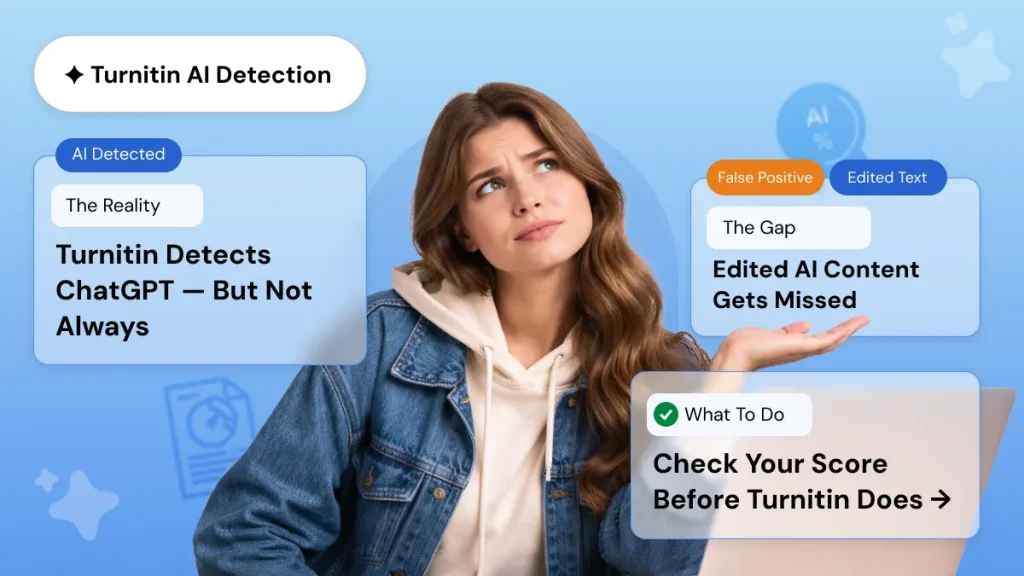
The problem? These systems are far from perfect. Turnitin admits its model intentionally misses about 15% of AI-written content to keep false positives below 1%. But independent research paints a grimmer picture. Stanford researchers found that 61% of TOEFL essays written by non-native English speakers were incorrectly flagged as AI-generated. For ESL writers, the false positive rate climbs to 8-12%, roughly double the average. Vanderbilt University disabled Turnitin’s AI detector entirely after calculating that approximately 750 student papers would be incorrectly flagged per semester.
So if you are an international student, a non-native speaker, or simply someone who writes in a formal academic style, you face higher odds of being wrongly accused. That is where an essay humanization service makes a real difference.
What a Real Human Writer Does Differently
Plenty of tools claim they can humanize AI essay content. Most of them fail. Turnitin updated its detection system in August 2025 with dedicated bypasser detection specifically targeting AI humanizer tools. Independent tests by Professor Tadhg Blommerde at Northumbria University showed that after this update, some popular humanizer tools jumped from 0% AI scores to 67-72% flagged. The arms race between automated humanizers and Turnitin is ongoing, but the detection side is winning more often than not.
Real human writers operate differently. They do not swap synonyms or shuffle sentence order. They rewrite from the ground up, incorporating the natural inconsistencies that define human writing.
Elements of Genuine Essay Humanization
Here is what genuine essay humanization looks like:
- Varied sentence rhythm. Writers intentionally mix short declarative sentences with longer, more complex constructions. This creates the uneven burstiness that AI struggles to replicate.
- Personal voice and examples. Human writers inject specific anecdotes, field-specific observations, and individual perspective that no AI model trained on generic data can predict.
- Natural transitions. Instead of robotic connective phrases, skilled writers use conversational transitions that reflect how people actually communicate in academic settings.
- Context-aware vocabulary. A human writer chooses terminology based on deep understanding of the subject, not statistical probability of what word comes next.
Why Students Need a Turnitin AI Humanizer Now
The scene has shifted. Turnitin for students used to mean a simple plagiarism scan. Today it means a multi-layered AI investigation. Turnitin scan results now include cyan highlighting for standard AI detection and purple highlighting for AI-paraphrased content since the July 2024 AIR-1 update. Your professor sees a similarity score along with an AI percentage, sentence-level analysis, and flags for suspected bypass attempts.
If you are using ChatGPT, Claude, Gemini, or any other LLM to draft content, you need more than basic editing. You need a strategy that addresses every layer of detection. Many students looking to bypass AI essay detectors quickly realize that automated tools alone cannot keep up with Turnitin’s rapid updates.
Common Traps That Get Students Flagged
Table
| Situation | Why Turnitin Flags It |
|---|---|
| Submitting raw ChatGPT output without editing | Low perplexity and uniform burstiness create an instant flag |
| Using QuillBot or basic paraphrasing tools | Turnitin’s AIR-1 model specifically detects AI-paraphrased content in purple highlights |
| Running text through automated humanizer tools | The August 2025 bypasser detection update catches known humanizer signatures |
| Writing in a formal, structured academic style | Even human writing with low variation can trigger false positives |
The students who avoid problems are not the ones submitting raw AI output. They are the ones who understand how detection works and take the right steps to create genuinely human-sounding work.
How Our Essay Humanization Service Works
At bypassessaydetectors.com, we do not use automated spinners or synonym swappers. We connect you with qualified human writers who specialize in creating content that passes Turnitin AI detection, GPTZero scans, and every other major detector on the market.
The process is straightforward. You submit your draft, outline, or source materials. A writer in your field reworks the content from scratch, preserving your ideas and arguments while adding the natural variation and human voice that detection systems recognize as authentic. Every submission gets checked against multiple AI detectors before delivery, including Turnitin, GPTZero, and others.
Who This Service Helps Most
This approach serves a range of needs:
- Students with legitimate AI drafts who need help making the writing sound human
- Non-native English speakers whose natural writing style triggers false positives
- Anyone facing tight deadlines who needs quality work that will not get flagged
- Students who want to bypass GPTZero and other detectors with equal confidence
The goal is not to help you cheat. It is to level a playing field where detection systems are demonstrably biased and frequently wrong.
How to Beat Turnitin AI Detection: Practical Strategies
Even if you work with a humanizer service, understanding how detection works helps you make better decisions. Here are proven methods that actually move the needle.
Vary Your Sentence Length
This is the single most impactful change you can make. Follow a 25-word sentence with an 8-word one. Add a fragment occasionally if your writing style allows it. Turnitin measures burstiness carefully, and uneven rhythm is the hardest pattern for AI to fake.
Add Specific Examples
Generic AI output relies on broad statements. Insert a specific case study, a personal observation from a lab or internship, or a reference to a recent event in your field. These details have low statistical predictability, which increases perplexity scores in your favor.
Use Natural Transitions
Phrases like “furthermore,” “in conclusion,” and “it is important to note” appear constantly in AI output. Replace them with natural connectors. “But here is the thing” or “That brings us to the core problem” sounds more human than any template phrase.
Edit in Multiple Passes
Human writing evolves through revision. If you submit something that reads like a single draft, it raises flags. Make structural changes, then revisit for style, then proofread. Each pass introduces the small inconsistencies that signal authentic human effort.
Check Before You Submit
Use a reliable AI detection remover check or pre-screening service. Knowing your score in advance beats finding a problem after your professor sees it.
Turnitin vs. GPTZero: What You Are Actually Up Against
Understanding the difference between detection systems matters. Turnitin is the institutional heavyweight. It is harder to access as an individual student because your school needs a license, but it is also harder to bypass because of its deeper architecture and training on 900 million student papers. Turnitin suppresses scores below 20%, meaning any flag you do see carries real weight.
GPTZero is more accessible and widely used by individual educators. It relies heavily on perplexity and burstiness metrics, making it somewhat easier to fool with manual editing. However, GPTZero’s accuracy varies wildly in independent tests, ranging from 52% to 95.7% depending on the benchmark. Some students worry about GPTZero when they should worry about Turnitin, and vice versa.
If you need to bypass both, real human rewriting remains the most reliable approach. Automated tools that claim to beat every detector typically fail against at least one major system. Human writing passes all of them because it is genuinely human.
The Bottom Line
Turnitin checks have become more sophisticated, more aggressive, and more punishing for students. The 9.9 million papers already flagged for AI content represent real academic consequences for real people, many of whom did nothing wrong. False positives are not a theoretical problem. They are a documented crisis, especially for international students and non-native writers.
You have options. You can spend hours manually rewriting every sentence, gambling that you have introduced enough variation to satisfy an imperfect algorithm. Or you can work with a professional essay humanization service that understands detection systems and builds content around real human writers.
The choice comes down to how much you trust an algorithm that thinks 61% of TOEFL essays are written by machines.
Frequently Asked Questions
What is a Turnitin AI humanizer service?
A Turnitin AI humanizer service rewrites AI-generated or flagged content using real human writers rather than automated tools. The goal is to produce natural, human-sounding academic writing that passes Turnitin AI detection and other scanning systems.
Can Turnitin detect AI content from ChatGPT or Claude?
Yes. Turnitin detects content from GPT-3.5, GPT-4, GPT-4o, Claude, and Gemini. Since mid-2025, it also flags text processed through AI paraphrasing tools and some automated humanizer services.
Is using a humanizer service considered cheating?
Our service provides writing assistance similar to tutoring or editing support. We rewrite and refine content to help students express their own ideas in their own voice. Academic integrity policies vary by institution, so you should review your school’s specific guidelines.
How accurate is Turnitin AI detection really?
Turnitin claims 98% confidence but admits to intentionally missing about 15% of AI content to limit false positives. Independent studies show accuracy rates as low as 39.5% when adversarial techniques are applied. False positives affect non-native English speakers at rates 2-3 times higher than average.
What is the difference between Turnitin and GPTZero?
Turnitin is an institutional tool integrated into school LMS platforms, scanning for both similarity and AI content. GPTZero is a standalone tool accessible to individuals. Turnitin generally offers deeper analysis and is considered harder to bypass, while GPTZero accuracy varies more in independent testing.
How fast can I get my humanized essay back?
Most essays are delivered within 24-48 hours depending on length and complexity. Rush options are available for tighter deadlines.
Will my professor know I used a humanizer service?
No. Human-written content does not contain the statistical signatures that AI detection systems flag. As long as the work reflects your ideas and arguments, there is no technical trace of the rewriting process.
What file types and languages do you support?
We support all major document formats including .docx, .pdf, and .txt. Our primary focus is English-language academic writing, which aligns with Turnitin’s AI detection capabilities.
Official Turnitin Documentation:
For a deeper understanding of how similarity scores work and what your professors see during a Turnitin check, refer to the official student guide:
Beat Plagiarism & AI Detectors with Confidence
Worried about plagiarism scores or AI detection flags? Get Plagiarism reports, expert humanization, and original papers written from scratch — all in one place and before your deadline.
100% Confidential • Turnaround as fast as 3 hours • Money-back guarantee