

Predictive language models shape AI detection scores by lowering perplexity and burstiness. See how Turnitin reads these signals and rewriting helps.
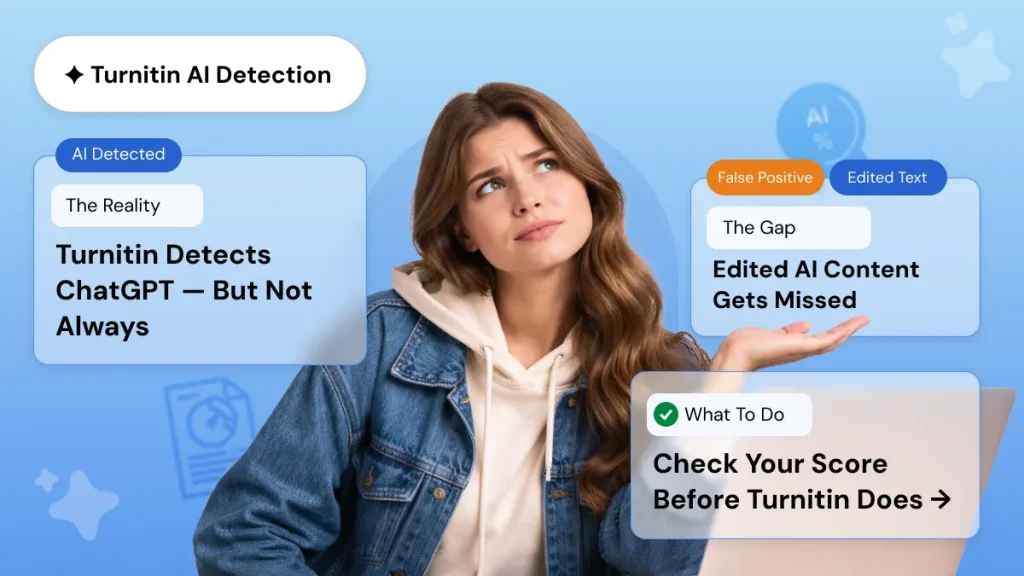
How Predictive Language Models Shape What Turnitin Sees
How do predictive language models impact AI detection scores? The answer is not obvious at first glance. These models guess the next word based on probability. When they do that well, the text becomes too predictable. Turnitin notices. So does GPTZero. The result is a flag that says your essay smells like a machine, even if you spent hours refining the prompt.
This matters because most students now use AI at some point in their writing process. Maybe you generated an outline. Maybe you asked for a paragraph on Keynesian economics. Maybe you used an essay humanizer to clean it up. Whatever your workflow, you need to understand what the detectors are actually measuring. It is not intent. It is not originality in the creative sense. It is statistical pattern matching, and predictive language models leave fingerprints that are hard to erase.
What Predictive Language Models Actually Do
A predictive language model looks at a sentence and calculates what word probably comes next. It does this by training on billions of text snippets. The model learns that after the phrase “in conclusion,” the next word is often “the.” It learns that academic essays tend to use “furthermore” more often than “plus.” These patterns are not wrong. They are just averages.
When you generate a full essay with one of these models, every sentence becomes a chain of likely choices. The text flows smoothly, maybe too smoothly. There are no odd word choices. No sudden shifts in rhythm. No sentences that start with “But” and end three words later. That uniformity is exactly what AI detectors hunt for.
Why Low Perplexity Sets Off Alarms
Perplexity is a measure of surprise. Human writing surprises readers. We use slang in the middle of a formal paragraph. We write short sentences after long ones. We pick words that are technically wrong but emotionally right. Predictive language models avoid surprises. They pick the safest next word every time.
Turnitin’s AIW-2 model scans for this safety. When a block of text has low perplexity, it means the word choices are too predictable. The model flags those segments as likely AI-generated. Independent testing shows that unedited ChatGPT output can score 90% or higher on Turnitin’s AI scale. That is not because the facts are wrong. It is because the word-by-word choices are too statistically likely.
The Burstiness Problem
Burstiness measures how much your sentence lengths vary. Humans write in bursts. One sentence might be eight words. The next might be thirty. Then a twelve-word fragment. AI tends to smooth this out. It produces paragraphs where every sentence sits in a comfortable middle range.
Turnitin checks for this metronome effect. When burstiness is low, the detector suspects machine involvement. This is why a simple human rewrite can change your score. If you break a long sentence into two short ones, or combine three choppy sentences into a flowing complex one, you alter the burstiness profile. You are not tricking the system. You are writing more like yourself.
How Turnitin Reads the Signals
Turnitin does not search the internet to see if your text exists elsewhere. That is the similarity report. The AI detection report looks inside your prose. It breaks your document into overlapping windows of five to ten sentences. Each window gets a score from 0 to 1. A score near 0 means human. A score near 1 means AI. The system then averages these across your whole paper.
From AIW-1 to AIW-2 and AIR-1
Turnitin launched its first AI writing detector, AIW-1, in April 2023. It was a basic classifier trained on human and AI text pairs. By late 2023, AIW-2 replaced it. This newer model was trained on a broader mix, including AI-generated text that had been run through paraphrasing tools. Then in July 2024, Turnitin added AIR-1, a model that specifically looks for AI-paraphrased sentences.
The AIR-1 model matters because many students think they can beat Turnitin AI detection by running their draft through a spinner. That used to work better. Now Turnitin looks for the statistical signature of rewriting tools. If you take an AI paragraph and swap synonyms, AIR-1 can still flag it. The model recognizes that the underlying structure is too uniform, even when the vocabulary changes.
The 20% Threshold and What It Hides
Turnitin only shows a specific AI percentage if more than 20% of your sentences cross the threshold. Below that, you see an asterisk. The company does this because its own research shows higher false positive rates in the 1-20% range.
This threshold creates a strange incentive. If 19% of your essay is AI-generated, Turnitin displays *%. If 21% is AI-generated, it might show 35%. That jump can mean the difference between a quiet pass and a meeting with your professor. It is not merely a measure of cheating. It is a measure of pattern density.
The False Positive Trap
Here is the part that gets overlooked. These detectors are not perfect. Turnitin claims a false positive rate below 1% for documents above the 20% threshold. But that claim comes from controlled tests with clean data. In actual practice, things get messy.
When Human Writing Looks Like a Bot
Researchers at Stanford found that AI detectors flagged 61% of essays written by non-native English speakers as AI-generated. The reason is simple. When you are learning a language, you write more carefully. You use simpler sentences. You avoid risky vocabulary. To a detector, that caution looks like machine predictability.
Technical writing suffers the same problem. A lab report full of standard phrases can trigger flags. So can a literature review that uses the same transitional phrases every professor expects. The detector sees patterns, not people. It cannot tell the difference between a cautious student and a chatbot.
What This Means for Students
If you are using Turnitin for students, you need to know the limits. The AI score is not a plagiarism score. A paper can have 0% similarity and 80% AI detection. That means you wrote original sentences that sound too much like a machine. It also means the detector can be wrong.
Report Delays and File Issues
Sometimes the AI report does not appear at all. Turnitin requires at least 300 words of prose to run the AI detector. Scanned PDFs, password-protected files, and certain PowerPoint themes break the extraction. If you resubmit too many times, the system delays the report by 24 hours. These file issues and report delays add stress to an already tense process.
Common File Mistakes
Students often lose time over simple formatting errors. A PDF that looks fine on your screen might be an image with no selectable text. A file with visual effects might crash the extractor. Even an Apple Pages document can fail if you do not convert it properly.
Scanned PDFs and Password Protection
Turnitin cannot read a scanned PDF or a locked document. The system needs highlightable text. If you upload a photo of an essay, the similarity report might process, but the AI report will not. Always check that your file allows text selection before you submit.
Official Turnitin Documentation:
For a comprehensive overview of AI writing detection architecture and report requirements, refer to the official support guides: ‘Turnitin product updates and AI writing score visibility’.
Human Rewrite Workflows for Clarity, Tone, and Originality
So what do you do if your draft gets flagged? The answer is not to find a magic AI detection remover. The answer is to rewrite like a human. Human rewrite workflows for clarity, tone, and originality are the only reliable way to produce writing that reflects your own thinking.
Start by reading the flagged paragraph out loud. If it sounds like a textbook, it probably reads like one to Turnitin too. Break up the rhythm. Insert a personal observation. Change a formal phrase to something you would actually say. These edits are not about deception. They are about making the text yours.
Practical Editing Tips for Polishing AI-Generated Content
If you used an AI tool to draft your essay, you can polish AI-generated content to maintain clarity, trust, and brand tone without gaming the system. Here is how:
- Read every sentence and ask if you would write it that way. If not, change it.
- Add specific examples from your own experience or course materials.
- Vary sentence openers. Do not start three sentences in a row with “The.”
- Replace generic transitions with your own. Instead of “furthermore,” try “this brings up another point.”
- Insert one short, punchy sentence per paragraph. It breaks the machine rhythm.
- Check for lists of three. AI loves triplets. Break them up.
These practical editing tips for polishing AI-generated content help you beat Turnitin AI detection the honest way. You are not trying to create an undetectable AI essay. You are trying to write a real one.
Essay Humanizer Tools for Clearer Academic Writing
Not everyone has time to manually rewrite every paragraph. That is where an essay humanizer comes in. A good AI essay humanizer does not just swap synonyms. It restructures sentences, adds natural variation, and preserves your meaning. The best humanizer for academic writing treats your draft as a starting point, not a finished product.
Best AI Humanizer for Essay
When you look for the best ai humanizer for essay, avoid tools that promise 100% undetectable AI essay output. Those tools often use tricks that AIR-1 can spot. Look instead for services that offer human rewrite workflows. They should let you review every change. They should preserve your citations. They should improve clarity without adding fluff.
What to Look For
A quality essay humanization service focuses on clarity. It will lower your AI score naturally by increasing perplexity and burstiness in authentic ways. Real human editors vary sentence length. They use contractions where appropriate. They insert the occasional informal phrase. These are not errors. They are signs of a living writer.
Promises That Are Too Good to Be True
Any tool that claims to bypass GPTZero or beat Turnitin AI detection with a single click is selling a fantasy. Detectors update constantly. The only safe approach is a service that edits your work transparently and teaches you how to improve your own writing.
AI Humanizer for Professional Writing
The same principles apply outside school. An AI humanizer for professional writing helps marketers, bloggers, and consultants avoid the flat tone that AI produces. If you use AI to draft a white paper, a humanizer can add the nuance that convinces clients you actually wrote it.
AI humanizer use cases for professional writing and brand voice include press releases, LinkedIn posts, and grant proposals. In each case, the goal is not to bypass GPTZero or beat Turnitin AI detection. The goal is to sound like a person. Predictive language models flatten voice. A humanizer restores it.
Can You Really Bypass AI Essay Detectors?
Let me be direct. The internet is full of promises about how to bypass AI essay detectors. Most of them are outdated. Turnitin’s 2025 update added bypasser detection specifically to catch text that was humanized by automated tools. GPTZero has gotten sharper about spotting pasted blocks. Copyleaks now checks structural signatures across thirty languages.
If your strategy is to humanize AI essay output with a single click, you are playing a losing game. The detectors update faster than the bypass tools. What worked in 2024 will not work in 2026. The only sustainable approach is to use AI as a research assistant and then write the final draft yourself.
That said, understanding how predictive language models impact AI detection scores gives you an edge. You know why the flag appears. You know that breaking sentence uniformity helps. You know that personal examples add unpredictability. You are not trying to trick a machine. You are learning to write in a way that machines cannot replicate.
Frequently Asked Questions
General Questions
Why does my human-written essay get flagged by Turnitin?
Non-native speakers, technical writers, and anyone who uses formal, consistent prose can trigger false positives. Turnitin’s model sees low perplexity and assumes machine involvement. Keep your drafts and revision history to prove your process if you need to appeal.
How do predictive language models impact AI detection scores on short essays?
Turnitin needs at least 300 words to run the AI detector. On short essays, the model may not generate an AI score at all. If it does, a single AI-generated paragraph can push you past the 20% threshold quickly because the denominator is small.
Can Turnitin detect AI paraphrasing?
Yes. Turnitin’s AIR-1 model specifically looks for text that was AI-generated and then rewritten by a paraphrasing tool. Simple synonym swaps do not work anymore. The model detects the underlying statistical structure.
What is the best way to humanize AI essay content?
The best way is to rewrite it yourself. Use AI for outlines and research, not final prose. If you need help, use an essay humanizer tool that focuses on clarity and tone, not one that promises to bypass GPTZero with hidden tricks.
Do essay humanizer tools work for professional writing too?
Yes. An AI humanizer for professional writing can adapt brand voice, improve readability, and remove the generic transitions that AI loves. These tools work best when you treat them as editors, not ghostwriters.
How long does Turnitin take to generate an AI report?
Most reports process within minutes. Resubmissions after the third attempt can trigger a 24-hour delay. Unsupported file types, scanned PDFs, and system outages can also block the report.
Is there a safe way to check my AI score before submitting?
Turnitin does not sell individual licenses. Students cannot run their own checks. Some third-party tools exist, but their accuracy differs from Turnitin’s internal models. The safest route is to write originally and keep drafts.
Can I get a false positive on a fully human-written paper?
Yes. Turnitin acknowledges higher false positive rates below the 20% threshold. At scale, even a 1% false positive rate means hundreds of students per university get wrongly flagged. Do not panic if it happens to you.
Beat Plagiarism & AI Detectors with Confidence
Worried about plagiarism scores or AI detection flags? Get Plagiarism reports, expert humanization, and original papers written from scratch — all in one place and before your deadline.
100% Confidential • Turnaround as fast as 3 hours • Money-back guarantee